
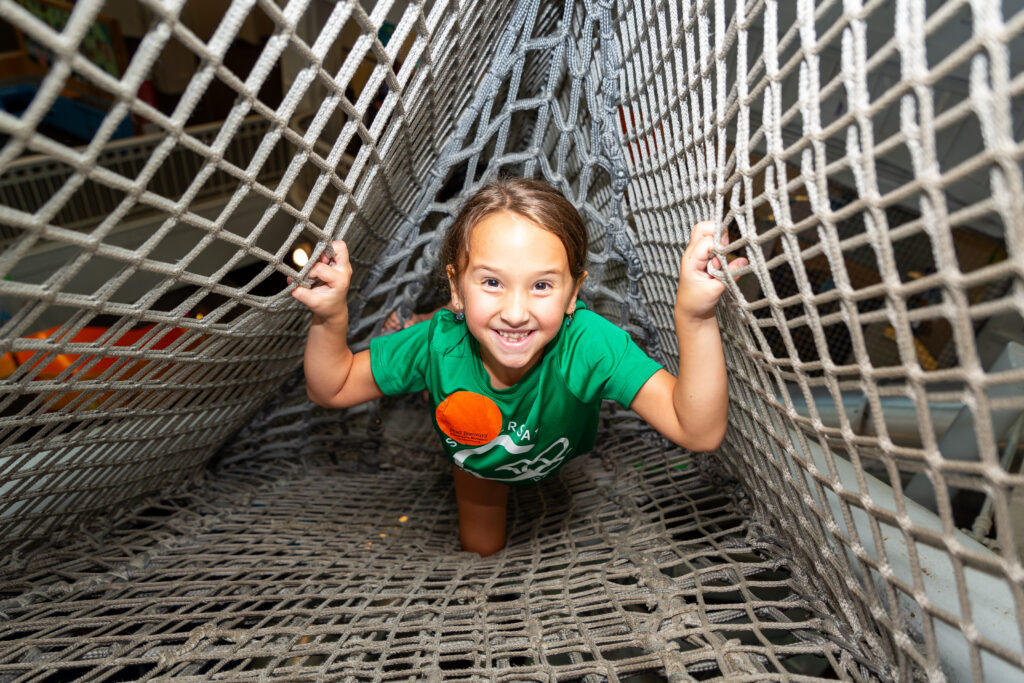
When “I’m Too Scared” Becomes “Let’s Try Again!”, discover how the Storm Slide helps children build confidence through safe, risky play.
If you’ve ever watched your child pause before a big challenge and wondered whether to encourage them or wait for them to make the first move, this might change how you think about those moments. You may have even caught yourself in a pattern of advising, “Be careful!”, a well-meaning reminder that can unintentionally tell children the world is unsafe before they’ve had the chance to discover it for themselves.
The Storm Slide: Risky Play in Action
Four-year-old Amelia had lots of questions for me before she rode on the slide. “Is it fast? Is it scary? How high up are we?” After some encouragement, she inched onto the slide, stared down the first turn, took a big breath, and pushed herself forward. At the bottom, she started jumping up and down and sprinted back to the Sky Climber for another turn. Back at the top, she grabbed onto my knee, pushing her sweaty fly-aways back with her palm, and exclaimed, “It was fast… scary…dark…bumpy…AND REALLY FUN!” She threw her hands in the air and fell onto her back in a pile of giggles. She went on to slide three more times until it was time to move on to the Art Cove.
The Storm Slide by the Numbers
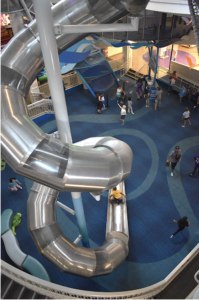
Walking into Port Discovery, it’s hard to miss the giant Sky Climber and its spiraling storm slide towering four stories above the center of the museum. For almost a decade, the slide has challenged kids and adults alike to conquer the climb and celebrate with a twisting, fast ride back down.
The giant slide became the perfect place to observe how children respond to a challenge. Over the course of eight hours, I watched 280 children decide whether to take the leap down the Storm Slide. While most raced down without a second thought, about 15% paused, saying they felt nervous or unsure. Even so, nearly 70% of those hesitant children chose to give it a try, while others decided to climb back down.
Notably, success isn’t only measured by going down the slide.
Sometimes it’s climbing to the top, taking a look, and deciding, “Not today.” Courage and self-trust can be built in the quieter moments of having the freedom to assess a challenge, make your own decision, and know when to walk away.
Even more striking, for the hesitant children who did choose to slide, the experience was overwhelmingly positive. Nearly 90% either immediately raced back up for another turn or happily moved on after one successful ride. Moments like these show that manageable challenges can help children build self-belief and emotional resilience. When a child discovers they can do something they once thought was too scary or not possible, it changes how they view themselves and stretches their sense of what they are capable of. Even for those who didn’t enjoy it, the experience was still an opportunity to test their limits and learn something about themselves.
What the Research Says About Children Taking Risks
 Decades of research in childhood development, including reports from organizations such as the American Academy of Pediatrics, support the importance of developmentally appropriate play. Researchers have found that when children engage in manageable challenges and uncertainty, they strengthen skills such as problem-solving, emotional regulation, decision-making, and perseverance. Researchers have also found that these experiences help children build confidence by giving them opportunities to discover their capabilities. Port Discovery has created a space where those moments happen every day. Children can test their abilities, evaluate challenges, and build confidence in an environment that is intentionally safe for exploration.
How Port Discovery Supports Character Development
In fact, Port Discovery is part of a larger cohort of museums who received a multi-year grant from the Lilly Endowment as part of their Fostering Character initiative. Perseverance, curiosity, and joy are all on display at the SkyClimber and are three of the Character Playful Powers at the center of the Lilly Endowment’s efforts to promote character development. Learn more about the project and explore the other cohort members.
For some kids, overcoming fear and putting those character traits into action could mean venturing through Adventure Expeditions, jumping from rock to rock to cross the river, standing inside the Pharaoh’s tomb, and reaching their hands into a dark opening to identify hieroglyphics by touch. Others cautiously approach Nimbus, the weather station’s talking gray cloud puppet, before he spits out rain onto his spectators. Additionally, whether crafting a bug in the Art Cove or constructing a rocket in Galactic Builders, many children and adults wrestle with the fear of getting it “wrong.” Hint: There is no wrong way to create or play at Port Discovery! These moments of fear and perceived danger may seem small, but they are important invitations for kids to grow by engaging in safe, manageable risks.
Take Amelia’s lead.
Sometimes confidence doesn’t begin with being fearless. Sometimes it begins with saying, “I’m scared,” taking one deep breath, and sliding anyway.
Want to learn more? Check out these additional resources:
- Bank, Heather Von. Why Kids Need to Take Risks. 2022. TEDxMNSU. www.ted.com, https://www.ted.com/talks/heather_von_bank_why_kids_need_to_take_risks.
- Bowen, E., and J. Voiklis. An Introduction to Character Education. ACM Trends 9.1. June 2026, https://childrensmuseums.org/fosteringcharacter/.
- Peter Gray, Ph.D. “Risky Play: Why Children Love It and Need It.” Psychology Today, 7 Apr. 2014, https://www.psychologytoday.com/us/blog/freedom-learn/201404/risky-play-why-children-love-it-and-need-it.
- Yogman, Michael, et al. “The Power of Play: A Pediatric Role in Enhancing Development in Young Children.” Pediatrics, vol. 142, no. 3, Sept. 2018, p. e20182058, https://doi.org/10.1542/peds.2018-2058.